RNZ financial crisis: Fears that cuts to Pacific services could further China’s influence
PACIFIC MEDIA WATCH: By Vaimoana Mase, Pasifika editor of The New Zealand Herald
As Radio New Zealand grapples with its $11.8 million blowout, there are fears the
broadcaster’s services to the Pacific could be impacted – enabling China to grow
its influence in the region.
In an open letter sent to caretaker Prime Minister Christopher Luxon - who was
bestowed a Samoan chief title earlier this year - and RNZ chairman Brent Impey,
the Asia Pacific Media Network (APMN) called for RNZ’s dedicated Pacific services
to be ring-fenced and protected from any budget cuts.
“The Pacific Service – started in 1990 and part of a Pacific broadcasting history
dating back more than 75 years – is a vital communication link with Pacific
nations,” the letter said.
“New Zealand is one of only two countries providing a shortwave service in the
South Pacific. The other country is China.”
APMN is an independent network of journalists, academics and researchers from
New Zealand and the Asia-Pacific region.
Its letter said Pacific countries rely heavily on RNZ Pacific’s radio news bulletins
and “its Cyclone Watch Service is potentially lifesaving”.
The letter was signed by APMN chairwoman Dr Heather Devere, who wrote of
concern for RNZ’s Pacific service amid efforts to rectify the broadcaster’s financial
position.
RNZ staff took to the streets this week, protesting outside its offices in Auckland
and Wellington, after news of the almost $12m blowout and plans to cut the
equivalent of 58 fulltime roles by March next year.
Hours after those protests, interim chief executive Mark Stevens warned no part of
the public broadcaster was safe. He said in an email that change proposals would
be shared from this week and, if implemented, staff would progressively leave RNZ
between next month and March 31.
Massey University associate professor Dr Anna Powles, who specialises in
geopolitics and security in the Pacific, told the Herald any reduction in RNZ news
services to the Pacific risked damaging New Zealand’s reputation.
“If you give up ground [like] surrendering shortwave radio access, then you are
effectively giving another country the opportunity and ability to advance their own
narratives.
“Those narratives may be counter to you and they may also be counter to the
Pacific.”
Over the past decade, China has developed a sustained policing, diplomatic and
economic presence in the Pacific, Powles said.
“New Zealand, Australia, the United States and so on were traditional partners in
the Pacific – that landscape is changing now. We now live in a world where many
more states are contesting for power.
“From a geopolitical perspective, the information environment is one of the key
domains in which geopolitical contestation is taking place.”
In January 2017, Australia switched off its shortwave radio transmissions across
the Pacific and China’s state-owned broadcaster took over some of those
frequencies formerly used by Australia’s ABC news service.
“The way in which China does engage in the region has become much more
targeted, much more strategic,” Powles said.
Asked about its response to the open letter, a Radio New Zealand spokeswoman
told the Herald: “Any proposals will be guided by our charter, audience needs and
strategy, with a focus on protecting audience services as far as possible.
“Our aim is to share information with affected teams as soon as possible and
provide opportunities for feedback. We will follow a full and fair consultation
process, meeting our obligations to staff and unions.”
RNZ Pacific, formerly known as Radio NZ International, started in 1990. However,
shortwave broadcasting from New Zealand to the Pacific started in 1948.
RNZ’s Pacific service broadcasts 24 hours a day, in English and Pacific languages,
in collaboration with 22 media partners, according to the letter.
“At the opening of its new shortwave transmitter in 2024, then Deputy Prime
Minister Winston Peters described the service as ‘seriously important’,” Devere
wrote.
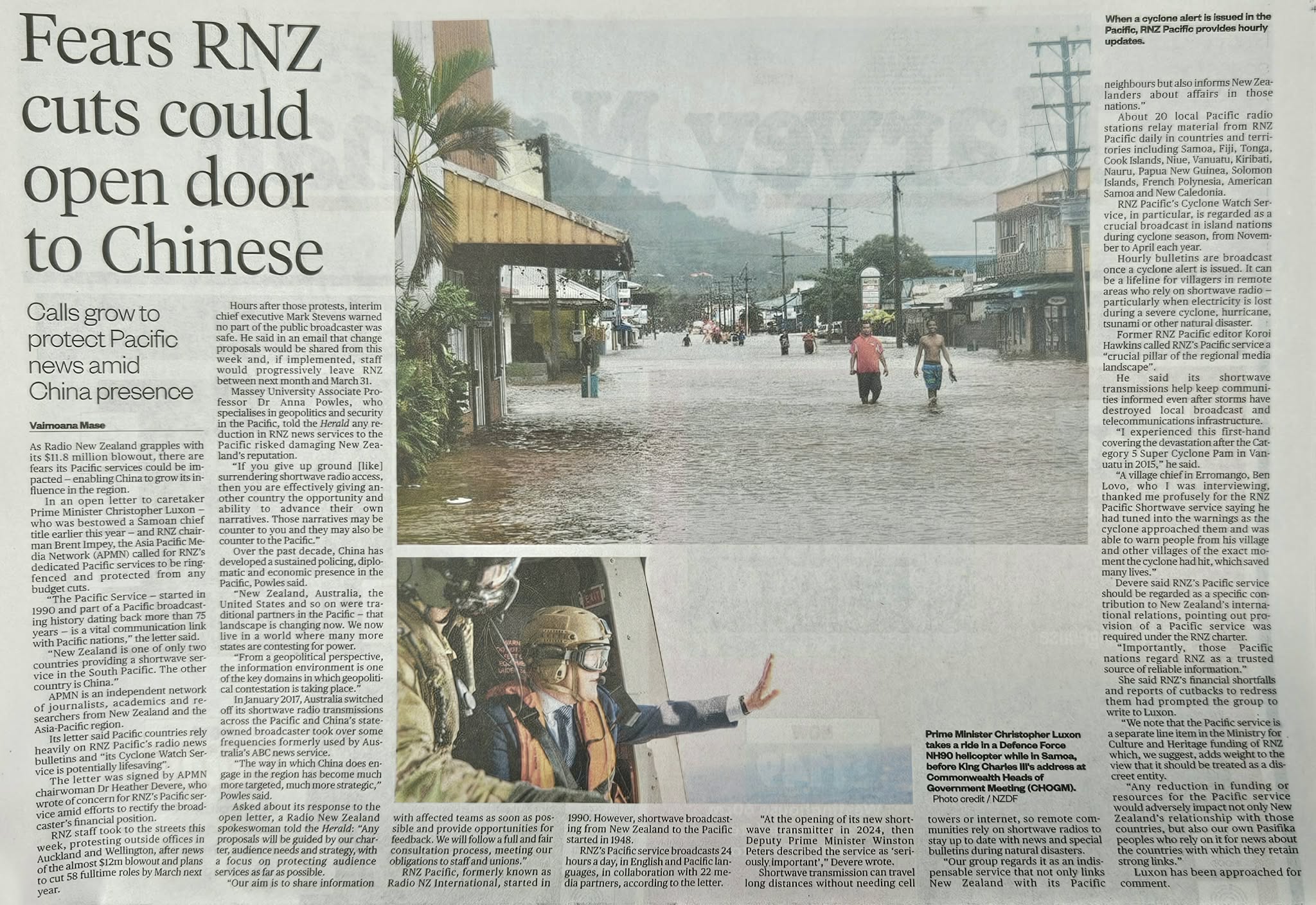
Shortwave transmission can travel long distances without needing cell towers or
internet, so remote communities rely on shortwave radios to stay up to date with
news and special bulletins during natural disasters.
“Our group regards it as an indispensable service that not only links New Zealand
with its Pacific neighbours but also informs New Zealanders about affairs in those
nations.”
Cyclone alerts a lifeline
About 20 local Pacific radio stations relay material from RNZ Pacific daily in
countries and territories including Samoa, Fiji, Tonga, Cook Islands, Niue, Vanuatu,
Kiribati, Nauru, Papua New Guinea, Solomon Islands, French Polynesia, American
Samoa and New Caledonia.
RNZ Pacific’s Cyclone Watch Service, in particular, is regarded as a crucial
broadcast in island nations during cyclone season, from November to April each
year.
Hourly bulletin updates are broadcast once a cyclone alert is issued. It can be a
lifeline for villagers in remote areas who rely on shortwave radio – particularly
when electricity is lost during a severe cyclone, hurricane, tsunami or other natural
disaster.
Former RNZ Pacific editor Koroi Hawkins called RNZ’s Pacific service a “crucial
pillar of the regional media landscape”.
He said its shortwave transmissions help keep communities informed even after
storms have destroyed local broadcast and telecommunications infrastructure.
“I experienced this first-hand covering the devastation after the Category 5 Super
Cyclone Pam in Vanuatu in 2015,” he said.
“A village chief in Erromango, Ben Lovo, who I was interviewing, thanked me
profusely for the RNZ Pacific Shortwave service saying he had tuned into the
warnings as the cyclone approached them and was able to warn people from his
village and other villages of the exact moment the cyclone had hit, which saved
many lives.”
Dr Devere said RNZ’s Pacific service should be regarded as a specific contribution to
New Zealand’s international relations, pointing out provision of a Pacific service
was required under the RNZ charter.
“Importantly, those Pacific nations regard RNZ as a trusted source of reliable
information.”
She said RNZ’s financial shortfalls and reports of cutbacks to redress them had
prompted the group to write to Luxon.
“We note that the Pacific service is a separate line item in the Ministry for Culture
and Heritage funding of RNZ which, we suggest, adds weight to the view that it
should be treated as a discreet entity.
“Any reduction in funding or resources for the Pacific service would adversely
impact not only New Zealand’s relationship with those countries, but also our own
Pasifika peoples who rely on it for news about the countries with which they retain
strong links.”
A spokesperson for Luxon declined to comment.
Vaimoana Mase is the Pasifika editor for the Herald’s Talanoa section, sharing
stories from the Pacific community. She won junior reporter of the year at the
then Qantas Media Awards in 2010 and won the best opinion writing award at
the 2023 Voyager Media Awards. Republished from APMN's Pacific Media Watch. Read the original report here (paywalled).
Post a reply